Posted on — Leave a comment

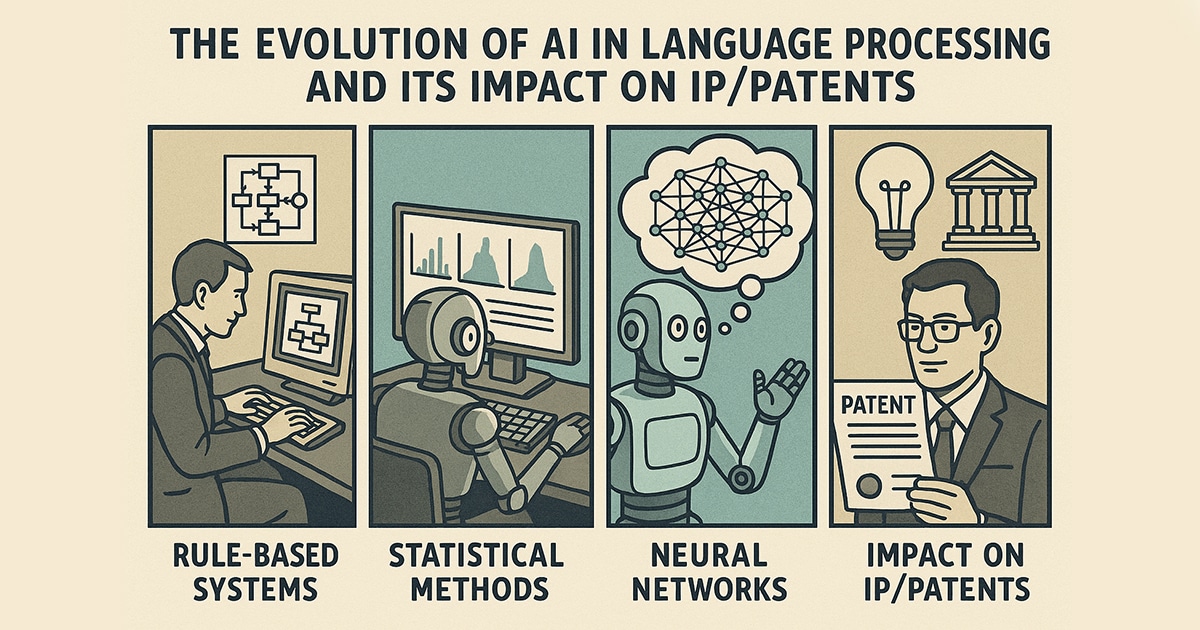
The Evolution Of Ai In Langauge Processing And Its Impact On Ip/Patents

AI's Impact on IP and Patent Processes

AI refers to machine learning models that generate new content such as text, images, audio, and video. One familiar example is LLMs, like ChatGPT, trained on vast datasets of internet text. These models are now performing a wide range of language tasks and showing real potential in the IP space. Let us look at its impact on IP patents industry.

Regarding Patent Search and Analysis, the LLMs help with prior art searches by scanning large databases and identifying relevant documents. This can significantly cut down the time attorneys spend looking for comparable inventions. They also assist with trend analysis by evaluating volumes of filings to reveal patterns and emerging tech areas—valuable insights for strategic planning.

The AI-assisted Patent Drafting provides a thorough explanation of the invention, is an essential component of the intricate process of creating a patent application. AI algorithms have been created to evaluate technical document content and categorize it into many preset groups.

The Intellectual Property Protection for AI-generated Inventions will result in the automation of jobs that are now done by people, continue to progress. As a result, the AI community will want less stringent intellectual property regulations. It seems sense that there would be some incentive for inventors to employ AI technology and then patent their creations, given the well-known role that patents play in the economy in encouraging innovation.

The latest impact of AI on IP/Patents is Language Processing Tasks. The LLMs excel at summarizing complex patent documents into digestible overviews, ideal for attorneys needing quick comprehension. Translation is another area of interest, and it’s here that a different AI approach takes the lead.

What Makes Us The Best Translation Services In India?

Posted on — Leave a comment

5 Ways To Ensure High-Quality Foreign Patent Translation Services

Quality Patent Translations

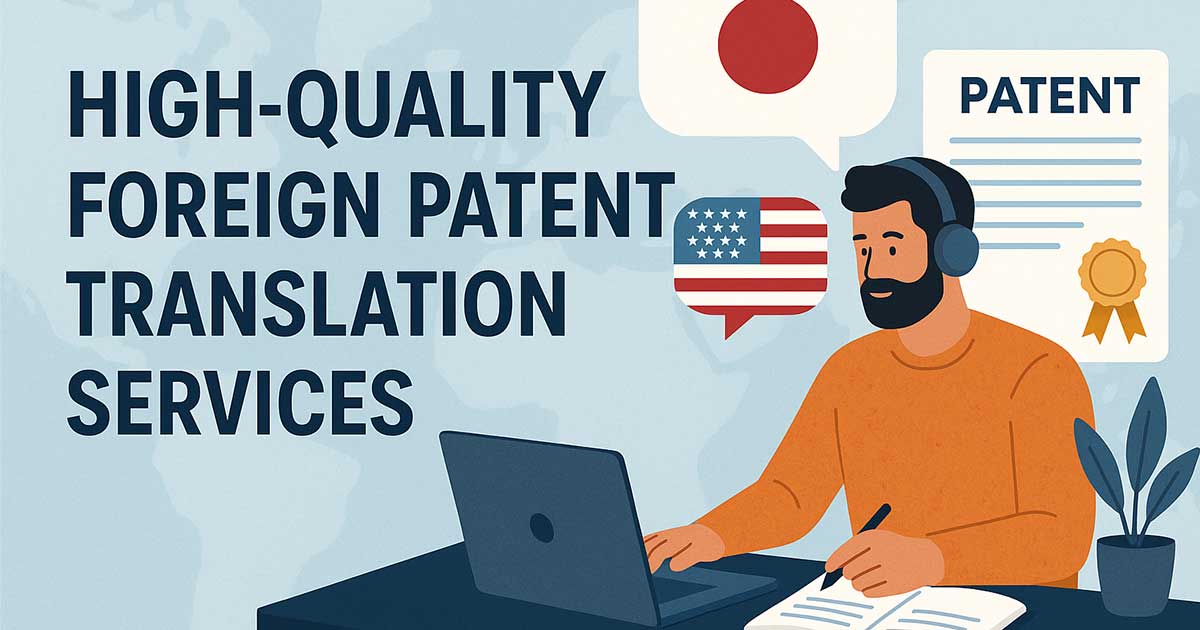
Patent translation is the most effective solution to protect your invention internationally. Even small and subtle discrepancies in patent filing and patent document can lead to legal, technical, and financial problems. Patent translations are the most sophisticated forms of translation that use industry-specific terminology to help safeguard your invention. There are five ways to ensure high quality foreign patent translation services given below.

  • Terminology assessment– Patent documents are highly subject and context specific and requires specific terminology/glossary and style guide to determine whether previously completed translations can be repurposed. Ensuring consistency across the portfolio is essential for reducing risk and maintaining clarity. the making of a client’s translation memory (TM), which is an electronic database that stores previously translated, edited, and proofread content segments, allowing them to be leveraged in future projects and avoid repetition.
  • Domain expert translator– due to the highly sophisticated nature of the patent industry, an experienced patent translation is crucial to maintain consistency in translation. . While technology has brought significant efficiencies and quality improvements to the patent translation process, human review remains the most critical element. Because even minor misinterpretations of technical terms or legal language can alter the scope of an invention or its protection.
  • Implement Automated Quality Assurance (QA) Tools- Automated QA tools acts as a secondary layer of error detection for expert translators for ensuring the quality of patent document translation. This last check helps to detect issues like inconsistent terminology, formatting mistakes, or missing claims that might otherwise slip through. Once the translations are complete, the provider should also update the client’s TM to enhance consistency and efficiency.
  • Review and Feedback System– A structured review process is crucial for improving consistency in a time-bound manner. Once your legal counsel or patent agents have reviewed the translation, their feedback should be shared with the translators to implement necessary revisions prior to filing.
  • Time constraint– Given the specialized knowledge involved in patent translation, the pool of qualified translators is smaller than for general legal content. For this reason, it’s critical to allocate sufficient time for the translation process is smooth and consistent.
Posted on — Leave a comment

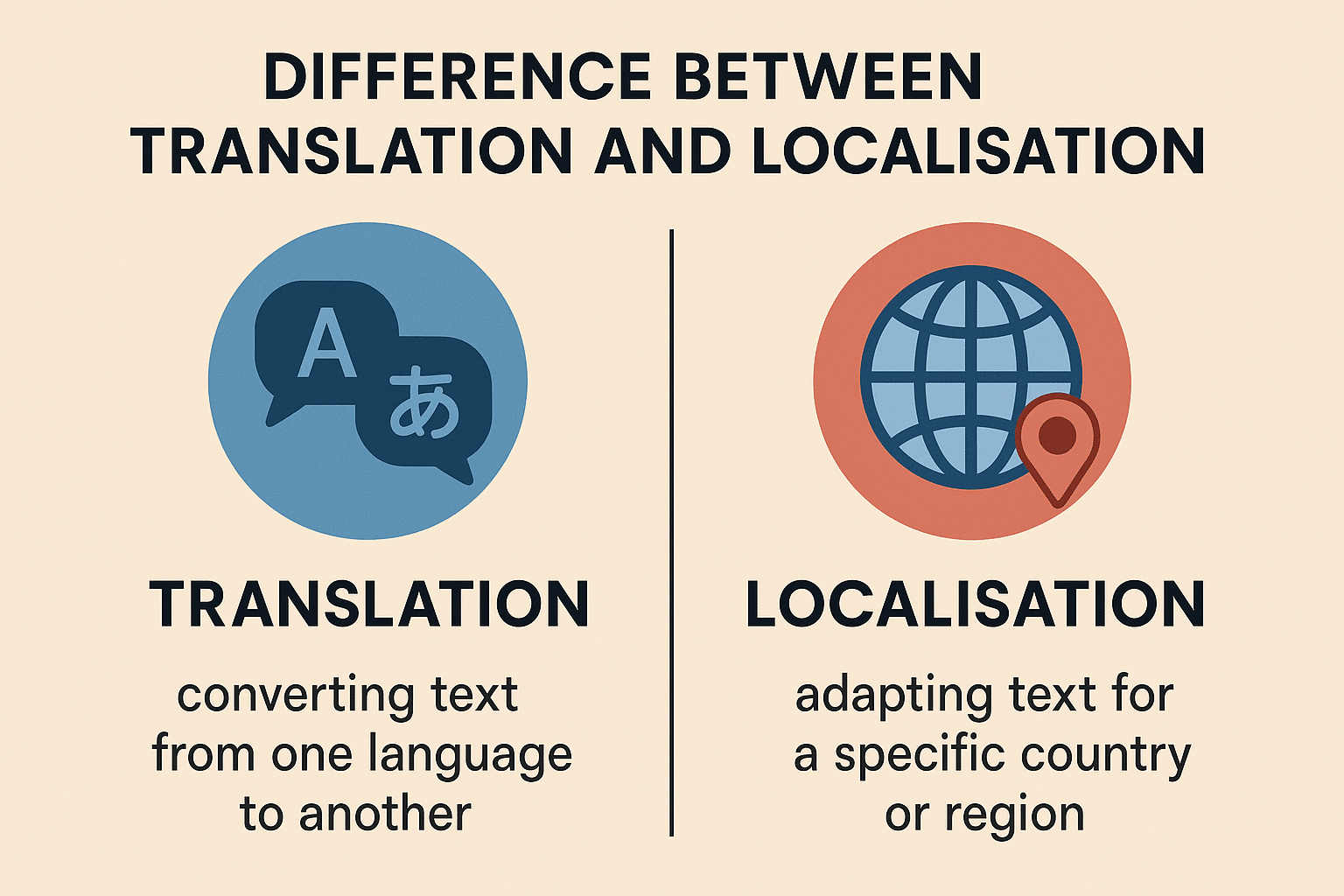
Difference Between Translation And Localisation

Translation and localisation may appear synonymous at a first glance but they are certainly not interchangeable terms. They vary in terms of their primary goal and focus areas. Translation can simply be defined as converting text or speech from one language to another, preserving the original meaning of the source document or speech. For instance, when a head of a country or an organisation gives a speech to an audience, an effective translation ensures that the original meaning, context and specifications are intact in the final document. Any deviation from its original character is considered a flaw and an inaccurate version of the original document.

Localization, on the other hand, is a more comprehensive process that adapts a product or service to a specific locale, taking into account cultural nuances, language, and other factors to make it feel native to the target audience. For instance, a marketing material for a company catering to Europe might take the original marketing document as a reference while translating it in different languages but, in a case where it targets a different market like Africa and Asia, they require a localisation process so that the examples and semiotics can be relatable to the target audience. Localizing a website for a Japanese audience might involve not only translating the text but also adjusting the layout, date and time formats, currency, and potentially even the imagery to align with Japanese cultural preferences.

To summarize, translation is a subset and often a first step of localization, while localisation is more context specific and end oriented. Localization takes translation a step further by adapting the entire experience to the target audience’s culture and preferences. While translation focuses on breaking language barriers, localization aims to break cultural barriers. For instance, a video game might require translation of the text, but localization might also involve adapting the game’s interface, characters, and even its storyline to resonate with the cultural context of the target audience.

Posted on — Leave a comment

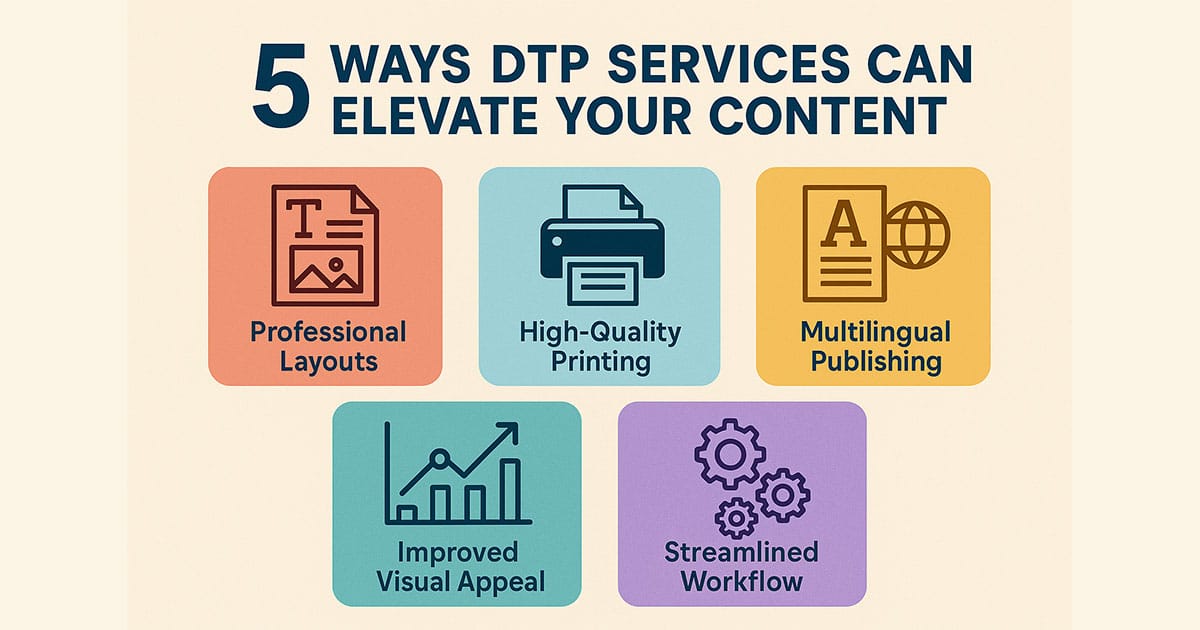
5 Ways DTP Services Can Elevate Your Content

5 Ways DTP Services Can Elevate Your Content

Any multilingual content for Desktop Publishing services has two essential components. The first component comprises of localization experts, and the second component has expert web designers. The effective collaboration between these two components can result in an accurate multilingual content which is easily comprehensible by natives and culturally sensitive, while delivering any type of DTP services. DTP services take care of cultural adaptability, aesthetics, user friendliness and accessibility of content by users across the world. Therefore, an effective DTP solution can certainly elevate your content that gives it a global and localised outreach. Here are five specific ways in which DTP services can elevate your content.

  • Visual appeal– If you content is not aesthetically pleasing and visually appealing, it is difficult to retain the attention span of a user and engage with your content and product. Therefore, an expert DTP services can significantly increase the visual appeal of your content and makes it more accessible.
  • Brand projection– A effective DTP service can ensure that your brand gets highlighted through specific signs, symbols and other means so that a brand awareness or product awareness can be created among the users. Through an effective DTP service, one can expect a brand consistency.
  • Format optimization– Not all formats have similar content and viability across all digital and print platforms. An effective DTP service can ensure your format optimisation that can ensure smooth availability of your product.
  • Accessibility– an effective DTP service can enhance and elevate your content by making it more accessible to users for easy understanding of your content
  • Audience Reach– the brand revolves around its accessibility and maximum reach to a wider set of audience. An expert DTP service can provide a large audience reach due to its customised usage of technology.

What Makes Us The Best Translation Services In India?

Posted on — Leave a comment

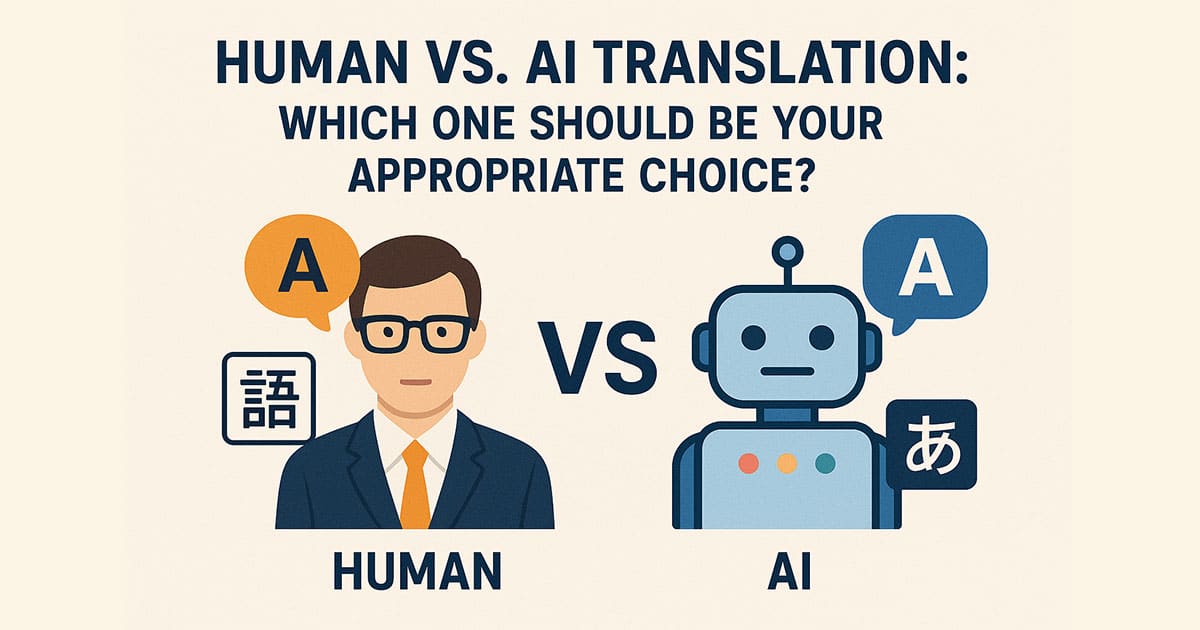
Human Vs Ai Translation, Which One Should Be Your Appropritate Choice?

AI or Human Translation Make the Right Choice

The history of Translation is more than 2000 years old. It has acted as a tool for the transfer of knowledge from one community to another in the most sophisticated way. The method and style of translation has been a subject of knowledge since its beginning, however, the revolutionary shift in translation came in the 21st century after the advent of machine learning in information sciences. While human translation is performed at the individual capacity of a translator, machine learning employs a technology that uses advanced algorithms to automatically convert text or speech from one language to another. The most advanced version of machine learning is artificial intelligence (AI). AI has been developed to store large language learning modules (LLMs) in its dataset. This helps the user to use AI services for translation almost like a mobile application. To make a decision on which translation is appropriate for your needs, a thorough difference between human and machine translation is required to assess their advantages and limitations. Let us understand them briefly.

There are six (6) important parameters that need to be taken into consideration while choosing between human and AI translation. Once a counterbalance and a preference cross referencing is assessed, an appropriate choice can be made regarding which translation service to be used.

  • Quality– The LLMs used in AI translation offers a high of accuracy but negligible errors. However, AI translation is not yet a perfect, 100% fail-proof solution. It still requires human proofreading for avoiding any inaccuracy when it comes to contextual and specific meanings. On the other hand, human translation is a much more reliable method of translation that are often done by their domain experts to maintain high level quality and context specification
  • Quantity– when dealing with a large volume of source document for translation, AI translation is much more efficient and precise. The high volume of source document may affect the translator’s consistency and accuracy. However, the domain expertise and experienced translators can overcome this challenge as well.
  • Time-management– whether the source document for translation is large or small, AI takes significantly less time than a human translator. It is always suggested to go for AI translation when there is a time constraint. However, a final proofreading may enhance the quality of translation in a time-bound scenario. It has been established that AI takes five times less time to translate a document for translation, including its proofreading time by a human translator.
  • Context-specific translation– while a translation work is undertaken, it is essential to under stand the nature of the document and the intent behind its translation. Documents that involve abstract language, such as humour, sarcasm, or cultural-specific idioms, figure of speech, homophones etc are often challenging for AI translation modules. On the other hand, it is highly suggested to utilise human translation in such scenarios.
  • Subjectivity– while AI translation modules are consistent in their output irrespective of their domain, the human translation is bound to have subjectivity. This means that human translation is different from one individual to another, depending upon their expertise, experience and personal level of efficiency. Therefore, subjectivity comes with human translation.
  • Field of translation– There are certain fields which have a significant database when it comes to LLMs, therefore, AI has proved to be more accurate in translation in any given scenario. Fields such as IT, finance, legal and engineering are much appropriate for AI software to translate while other fields such as marketing, medical, literary work and official documents are more context specific and thus require human translation to maintain a high quality of translation.

After a thorough assessment of all six parameters, the suitable option can be chosen for translation that prioritises one’s own specific requirement. However, it is an accepted norm to use both the AI and Human translation in a combined manner so that best results can be achieved. After an AI translation, the expertise of a professional human translator is still needed to verify its output and deliver that much-needed human touch. The combination of both for accuracy and timely submission, consistency and cost efficiency is the best solution.

What Makes Us The Best Translation Services In India?

Posted on — Leave a comment

Why Professional Translation Services Matter in a Globalized World

In today’s interconnected world, businesses and individuals often need to communicate across languages and cultures. Whether it’s expanding a business into international markets, applying for immigration, or sharing important personal documents abroad, accurate translation plays a critical role in ensuring clarity and trust. This is where professional translation services become invaluable.

In this blog, we’ll explore why professional translation services are important, the types of documents commonly translated, the risks of poor translations, and how to choose the right translation partner for your needs.


The Importance of Accurate Translation

Translation is much more than converting words from one language to another. It involves conveying the correct meaning, tone, and cultural context of the original message. A single mistranslation can lead to confusion, legal issues, or even business losses. Professional translators have the training and experience to accurately interpret both the literal and implied meaning of the source text.

For businesses, a well-translated document or website can help build credibility in new markets. For individuals, accurate translation of personal documents ensures smooth processing in legal, academic, or immigration matters.


Common Documents That Require Professional Translation

Professional translation services cover a wide range of documents, tailored to meet the needs of businesses, government agencies, and individuals alike. Here are some of the most commonly requested translation services:

  • Legal Documents: Contracts, court orders, affidavits, wills, and legal agreements.

  • Immigration Documents: Birth certificates, marriage certificates, passports, and academic records.

  • Medical Records: Patient histories, prescriptions, and medical reports for treatment abroad.

  • Business Documents: Company profiles, business plans, brochures, and marketing materials.

  • Technical Manuals: Instruction manuals, safety guides, and engineering documents.

  • Academic Transcripts and Certificates: For students applying to foreign universities or for job opportunities overseas.

  • Website and App Translation: To reach a global audience effectively through digital platforms.


Risks of Inaccurate or Machine Translation

While free online translation tools have improved over the years, they still fall short when it comes to accuracy, especially for official documents. Machine translations often lack an understanding of nuance, cultural context, and industry-specific terminology. Relying on these tools for critical documents can result in:

  • Legal issues: Misinterpreted legal terms can invalidate contracts or cause disputes.

  • Financial losses: Poorly translated marketing materials can damage a company’s reputation or fail to connect with local customers.

  • Immigration delays: Incorrectly translated personal documents can lead to application rejections or delays.

  • Medical errors: Inaccurate medical translations can result in dangerous misunderstandings about a patient’s health condition or treatment.

This is why it’s crucial to rely on professional translators, who are not only fluent in the target language but also familiar with the cultural and technical nuances of the content.


How to Choose the Right Translation Service Provider

When selecting a translation service, it’s important to consider several factors to ensure you receive reliable, high-quality results. Here’s what to look for:

1. Certified Translators:
For legal, academic, and official documents, it’s essential to work with certified translators. Many government bodies and institutions require certified translations for document validation.

2. Industry Expertise:
Different industries have their own terminology and jargon. A translator experienced in your specific field — whether it’s legal, medical, or technical — can ensure accuracy and relevance.

3. Turnaround Time:
Timely delivery is important, especially when dealing with legal deadlines, immigration processes, or business launches. Choose a service that offers reasonable turnaround times without compromising on quality.

4. Data Privacy:
Ensure that the service provider follows strict confidentiality policies, especially when handling sensitive personal, legal, or business information.

5. Positive Reviews and Reputation:
Look for customer testimonials, reviews, and case studies. A well-established translation company with positive feedback is more likely to deliver reliable services.


The Benefits of Partnering with a Professional Translation Agency

Working with a professional translation agency offers several advantages over freelancers or automated tools:

  • Consistency and Accuracy: Agencies have teams of translators, editors, and proofreaders to ensure consistent quality.

  • Certified Translations: Agencies can provide notarized and certified translations required for official use.

  • Multilingual Support: Most agencies offer services in multiple languages, enabling you to manage diverse translation needs in one place.

  • Dedicated Customer Support: Professional agencies offer dedicated support teams to handle inquiries, revisions, and updates promptly.

  • Competitive Pricing: While agencies may cost more than free tools or casual freelancers, they offer value for money through reliable, high-quality services.
Posted on — Leave a comment

The Ultimate Guide To Ai Translation Quality Assurance Tools

Ai Translation Quality Assurance Tools

Quality Assurance (QA) of a translated text has been a tedious and time taking task for centuries before the advent of artificial intelligence in the last decade. Traditional QA methods were dependent on human reviewers or proofreaders to catch issues like grammatical errors, inconsistencies, cultural inaccuracies, and stylistic problems. These problems can range from simple typographical and punctuation errors to more complex issues with sentence structure, semantic problems, terminology, and the overall flow of the text. However, the new generation of translation agencies and translators are more reliant on artificial intelligence tools to reduce the time and effort to avoid any inconsistencies in a translated text.

AI tools offer a consistent, fast, and data-driven approach which can solve all of the above issues in a sophisticated and time-bound manner. AI translation quality assurance refers to the use of artificial intelligence to automatically assess the quality of a translated text. These AI translation QA tools use machine learning, natural language processing (NLP), and quality metrics to catch errors, suggest improvements, and provide an overall score for translations. They’re especially valuable in large-scale projects or tight deadlines, where efficiency and reliability matter most.​ These tools can identify problems in grammar, semantics (meaning), terminology, and style which are often overlooked by human translator. The use of AI QA tools means fewer mistakes, better client satisfaction, and faster delivery.​

At ALS, we have AI-powered translation QA tools that are built to integrate seamlessly with popular CAT (Computer-Assisted Translation) and TMS (Translation Management System) platforms. This allows our translators to run quality checks at various stages during pre-processing, mid-translation, and post-editing. This real-time facility allows for immediate quality evaluation, minimizing the chances of errors slipping through and improving overall output consistency. If you’re managing large-scale localization efforts of your SaaS projects with multiple linguists and languages, these tools ensure that everyone adheres to the same quality standards, no matter where they’re working from.

Posted on — Leave a comment

5 Ways Software Translation Services Enhance Efficiency For Saas Companies

5 Ways Software Translation Services Enhance Efficiency For Saas Companies

SAAS companies are those set of companies who provide software as a service to other enterprises and business entities. These SaaS companies provide software applications over the internet, typically via a subscription model. They handle the infrastructure, maintenance, and updates, allowing users to access the software from any device with an internet connection. The role of translation in SaaS companies is indispensible to its day to day function and ultimate growth. Translation enhances SaaS companies’ efficiency in five different ways.

  1. Streamlining localization workflows- Translation management systems (TMS) automate tasks, like pulling and pushing content, and track localization statuses, simplifying the translation process and reducing manual effort.
  2. reducing costs- By leveraging translation memory, which stores previously translated content, SaaS companies can avoid redundant translation efforts and reduce costs
  • Enhanced user experience- Localized content, including user interfaces, help messages, and marketing materials, creates a more user-friendly and engaging experience for international users.
  1. They automate processes, leverage translation memory, and integrate with other systems to create a smoother, faster, and more cost-effective approach to global expansion.
  2. Faster Time to Market- By automating and streamlining the translation process, SaaS companies can accelerate their time to market in new regions and quickly reach a wider audience.

These above points are essential components by which SaaS companies can improve their standard and efficiency. At ALS, our expert translators provide in software localization help our client to reach their business goals in an efficient and time bound manner. We facilitate collaboration between teams, including developers, marketers, and translators, ensuring seamless communication and project management. We also help them comply with local regulations and legal requirements in different markets.

Posted on — Leave a comment

How Ai Translation Improves Accuracy In Legal And Medical Documents

How Ai Translation Improves Accuracy In Legal And Medical Documents

The last decade has witnessed revolutionary advancements in the field of Translation and localization services. The latest developments in artificial intelligence have direct impact on the translation industry. The development of AI has helped to develop a language corpus which has immensely helped in translation of different contents. AI translation or machine translation uses artificial intelligence algorithms to automatically translate text or speech from one language to another. Instead of translating word for word, these systems analyze the context and nuances of language to produce more natural and accurate translations. AI translation significantly enhances accuracy in legal and medical documents by leveraging advanced algorithms and machine learning to understand context, terminology, and nuances of complex languages. This leads to more reliable and accurate translations, crucial for legal and medical fields where precision is paramount.

At ALS, we utilize CAT tools and AI systems which have an extensive datasets of legal and medical texts, enabling them to learn the nuances of these fields, including specialized terminology and writing styles. AI algorithms can analyze the context of a sentence or phrase, ensuring the correct translation is used, even with ambiguous words or phrases. Our AI tools can identify and correct errors that might slip through in manual translation, such as misinterpretations or inconsistencies. AI can maintain consistency in the use of terminology and phrasing across multiple documents, which is crucial in legal and medical fields where precision is paramount. AI can also assist with legal research by translating legal documents and summarizing case law in different languages. Lastly, AI can analyze and compare translated documents to ensure consistency and accuracy

Posted on — Leave a comment

What Are The Best Language Pairs In The Translation Industry?

Language Pairs

In the field of translation, language pair signifies two languages, one being the ‘source language’ and the other being ‘target language’. Many of the most frequently translated language pairs involve English as one of the languages. This is because English is a widely used language in global business, technology, and other international fields. However, there are several other languages which are equally important and in demand when opted as a language pair with English. However, there are a few language pairs where English is not either the source or target language, yet these language combinations are in high demand due to market forces. Nevertheless, any set of combinations of different languages are driven by economic factors and market forces that has an end goal of global reach.  In this context, there are ten language pairs which are in high demand among global clients. These are as follows.

  1. English-Spanish– due to the large number of Spanish speakers and the influence of English in global communication, this language pair is the most sought after language pair globally.
  2. English-French– French is spoken across all continents (except Australia) and France and francophone nations have strict legal requirements for local language content and its open economy.
  • English to Portuguese– The large Portuguese-speaking population, especially in Brazil, drives the need for translation between English and Portuguese.
  1. English-Arabic- Arabic is a major language for translation due to its religious and cultural importance and its global reach. It is spoken in entire Middle East and North Africa.
  2. French-English- Translation in this direction is also significant, reflecting the importance of French in global business and culture. Just like English speaking companies who target businesses in Francophone countries, Francophone businesses also target Anglophone nations that make this language pair in great demand among translation agencies.
  3. English-Japanese: Japan’s influence in technology and popular culture contributes to the need for translation between English and Japanese.
  • Spanish-Portuguese: The geographical proximity and historical connections between Spanish-speaking and Portuguese-speaking countries contribute to this translation pair.
  • English-Chinese: China’s growing global presence and influence lead to a high demand for translation between English and Chinese.
  1. English to German: Germany’s strong economy and influence in many fields make it a major language for translation.
  2. English-Hindi– India being one of the biggest markets globally has given this language pair a prime importance for reaching new audiences and customers.